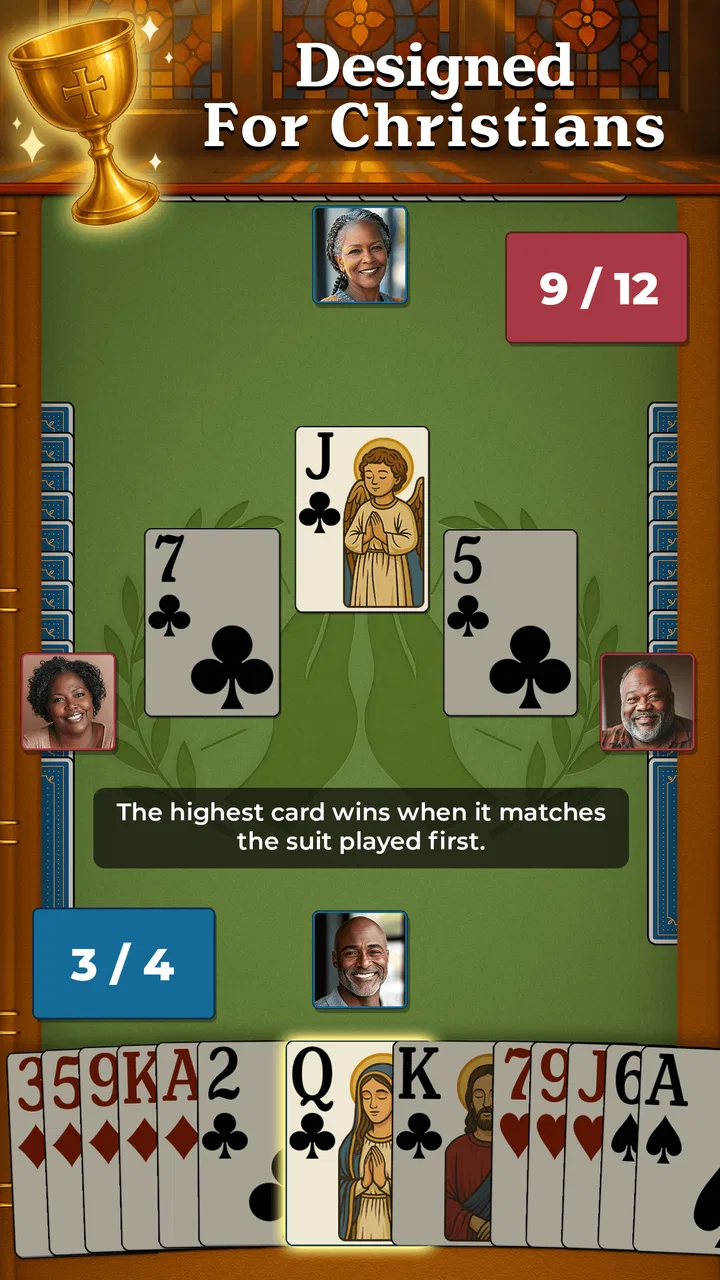
Bible Spades - Holy Card Game
- 4.8
- Rating
- 50.00K
- Installs
- Free
- Price

 Analysis by App-foxy
I approached Bible Spades - Holy Card Game as a quiet card-game option rather than as a replacement for every version of spades. That distinction matters. The appeal here is the combination of familiar trick-taking strategy and a faith-centered presentation, so the right question is not simply whether you enjoy card games. It is whether you want a slower, more reflective style of play that gives the traditional format a different atmosphere.
After spending time with it, I found the game easiest to appreciate in short sessions. It suits a break when I want something more thoughtful than a purely casual tap game, but less demanding than a large strategy title. The free price makes trying it simple, and the Everyone age rating gives it a broad audience. Still, the theme will be a major part of the decision: players looking only for a neutral or highly competitive card table may find other options more suitable.
How to decide if this version of spades fits you
The first thing I would consider is your relationship with the traditional game. Spades rewards planning, memory, risk assessment and cooperation with a partner. You need to estimate how many tricks your side can take, decide when to protect a bid, and notice which high cards have already disappeared. Bible Spades keeps that mental core at the center, so it is not just a decorative faith app with cards added around it.
You May Also Like

 Pandora - Music & Podcasts
Pandora’s Music Is Easy to Start, but Harder to Recover
Pandora’s strength is its low-effort path from a seed to a station. Its weak spot is how much confidence it asks you to place in connection, setup, and quiet recovery.

 8 Ball Pool
 Is Built on Rivalries, Rematches, and Routine
A close look at the rivalries, rematches, shared routines, and unanswered safety questions that turn a quick pool match into a persistent mobile community.

 Samsung Music
’s Quiet Strength Is Playing What You Already Own
Its reach comes less from spectacle than from dependable access to a personal library. That simplicity is both the app’s strongest retention engine and its ceiling.

 AccuWeather: Weather Radar
AccuWeather Review: A Quick, Clear Forecast for Everyday Decisions
For everyday plans, the best forecast is the one you can understand quickly. AccuWeather makes rain timing, radar, and local conditions easy to act on, with a few trade-offs.

 Hill Climb Racing
Why Hill Climb Racing Still Turns Crashes Into One More Run
A tiny car, a bumpy hill and one more upgrade: Hill Climb Racing keeps resurfacing because its simple chaos makes every near-miss feel personal.

 AliExpress - Shopping App
AliExpress Makes Global Shopping Feel Personal, but Shoppers Bear the Risk
AliExpress turns a global marketplace into a pocket-sized discovery engine. Its reach is useful, its shopping loop compelling, and its trade-offs easy to miss.
More From Our News Desk
View All News


The second criterion is mood. Many card games push speed, competition or constant rewards. This one is better approached when you want a calmer rhythm. I would choose it for a few hands after dinner, a quiet Sunday afternoon or a short break where I still want to make meaningful decisions. I would not choose it when I am looking for flashy action, a large social lobby or a deep collection system.
The third question is how much variety you expect from a mobile card game. A traditional spades player may be happy repeating the fundamentals and improving judgment over time. Someone who needs frequent new modes, dramatic progression or a large multiplayer community may quickly feel restricted. Since the experience is built around one recognizable card category, its strength is focus rather than breadth.
It is also worth thinking about who will play beside you. The Everyone rating makes it approachable for families and mixed-age households, while the religious framing may make it especially comfortable for players who want their entertainment to reflect their beliefs. In a family setting, I could see it working as a low-pressure way to introduce younger players to trick-taking concepts, provided an adult is willing to explain bidding and partnership play.
What the first few hands teach you
Spades can look simple until the bidding begins. In practice, the most useful early habit is to avoid treating every strong card as an automatic reason to bid aggressively. I pay attention to the number of likely winners, the possibility of being forced to play a spade, and whether my hand contains enough support to recover if the first plan fails. That makes the game more interesting than a basic matching exercise.
A practical tip is to use the opening hands as a calibration period. Rather than chasing an impressive score immediately, I watch how often my estimates are realistic. If I regularly overbid by one trick, I adjust before the mistake becomes a pattern. This is a better way to improve than simply blaming unlucky cards, because spades is often decided by small choices made before the first card is played.
Another useful habit is to remember suits that have already been exhausted. When a player cannot follow suit, the table changes: that player may now be able to use a spade at a valuable moment. I do not try to memorize every card at once. I focus on the highest cards and on the suits that are most likely to create a future void. That limited memory approach keeps the game manageable on a phone.
Partnership awareness is just as important. Even when the game does not let you communicate freely, your partner's bid and card choices provide information. A safe-looking play may be better than grabbing a trick if it protects the team from taking too many unwanted tricks later. That trade-off is where the title earns its place as a strategy game instead of merely a digital deck.
Where Bible Spades makes the strongest case
The clearest advantage is its focused identity. Bible Spades is a faith-oriented card game that does not need to pretend to be an enormous entertainment platform. For players who already enjoy spades, the religious setting can make familiar sessions feel more personally meaningful. For players who are curious about the genre but prefer a gentle presentation, it offers an approachable entry point.
I also like the way the theme changes the emotional context of a win or loss. A missed bid can still be frustrating, but the overall experience feels less like a frantic contest for attention. That makes it easier to play in small portions. I can finish a hand, put the phone down and return later without feeling that I have abandoned a long chain of rewards or a time-sensitive event.
The developer, Daily Bread Games, has positioned the product clearly enough that the audience can understand its purpose before installing it. That clarity is valuable. There is no need to download a generic card game and hope its tone matches your preferences. Here, the faith element is part of the reason to choose it, not something hidden behind unrelated menus.
The rating history also suggests that the concept has connected with its audience. It holds a 4.8 average from around two thousand ratings, with over five hundred written reviews. I treat that as encouraging rather than conclusive: a strong average tells me the core audience is satisfied, but it does not guarantee that a player who dislikes religious framing or traditional trick-taking will enjoy it.
Its reach is also respectable for a focused card title, with over fifty thousand installs. That gives the game a sense of legitimacy without changing what it is. I would still evaluate it on the quality of the hands and the fit of the theme, not on popularity alone.
Small decisions that improve the experience
I recommend playing from a stable routine instead of opening it only when bored. For example, I might play a few hands during a daily quiet period and use that time to work on one skill, such as conservative bidding or tracking spades. This turns repetition into practice. It also prevents the game from becoming a sequence of random hands with no sense of progress.
For beginners, the best starting goal is not winning every round. It is learning to distinguish a hand that can take tricks from a hand that merely contains attractive cards. A hand with one excellent card and several weak suits may behave very differently from a balanced hand with multiple medium-strength options. Thinking in terms of shape, not just individual card value, makes the decisions clearer.
For experienced players, I would experiment with restraint. The temptation in a familiar card game is to rely on instinct, but a faith-themed presentation does not make the underlying mathematics disappear. Before committing to a bid, I ask whether the hand has a recovery plan. If the answer is no, a modest estimate may be the more skillful choice even when the cards look exciting.
There is also a useful social scenario here. If a family member already knows basic card games but has never learned spades, I could use a few relaxed sessions to explain bidding, trump control and partnership signals. The game provides a more focused setting than a crowded general card app. That does not replace sitting around a physical table, but it can help someone understand the structure before joining one.
Where a different card game may fit better
The usual alternatives fall into several groups. A general-purpose card app is a better choice if you want many games in one place. It may offer solitaire, hearts, rummy or other familiar formats, while this title concentrates on spades. The trade-off is obvious: broader variety usually means less of the specific faith-centered atmosphere that makes this game distinctive.
A competitive online spades platform may suit you more if your priority is live opposition, rankings or a strong sense of public competition. I would look in that direction when I want to test my decisions against human players and measure improvement over a longer competitive journey. Bible Spades is the better fit when the table should feel calmer and the religious identity matters more than a tournament-style environment.
A physical deck remains preferable for people who mainly enjoy conversation and face-to-face partnership play. No mobile game can reproduce the pauses, jokes and informal teaching that happen around a real table. The phone version wins on convenience: it is available when another player is not. It loses when the social ritual is the main reason you play.
There is a similar distinction with highly animated casual games. Those titles may be better for a quick burst of visual stimulation, while this one asks me to concentrate on cards and decisions. If you want constant motion or a reward-heavy loop, choosing this game may feel like switching to the wrong tool. If you want mental space and a recognizable ruleset, the restraint is an advantage.
What switching to it feels like
The cost of switching is low in financial terms because the game is free. That makes it easy to test without committing money, and it is suitable for someone who wants a no-cost card option with a specific spiritual tone. The more important cost is attention: learning or relearning spades takes patience, especially if bidding is new to you.
Players coming from another spades app should expect the rules they know to carry much of the experience, but they should not assume that every familiar interface habit will transfer perfectly. I would give myself several sessions before deciding whether the pacing and presentation work for me. A first impression can be distorted by an unlucky run of cards or by needing time to adjust to the way choices are presented on a smaller screen.
The current release is version 1.22.0, and it runs on Android 8.0 or later. That makes the compatibility question fairly straightforward for many Android users, although I would still check the operating system on an older phone before planning to use it there. On a newer device, the more relevant decision is not technical access but whether a focused, faith-based spades experience is what you actually want.
I would also set expectations around replay. The game can remain interesting because the card situations change and because better bidding takes practice. However, repetition is part of the format. If you need a constant stream of new objectives, switching between several card genres or playing in a large social ecosystem will probably give you more long-term variety.
Who should install it, and who should pass
I would recommend giving it a try if you already enjoy spades, want a calmer mobile card session, or prefer games that openly include Christian themes. It is especially suitable for players who value simple access and want to improve through repeated hands rather than chase a complicated progression system. The free entry point removes the biggest barrier to testing that fit for yourself.
I would also suggest it to a beginner who is willing to learn gradually. The core rules reward observation, and the game can support short practice sessions. Start by making sensible bids, watch how trump cards affect the table, and treat mistakes as information. That approach is more productive than trying to imitate an experienced player immediately.
I would skip it if you dislike religious presentation, want a broad collection of card games, or need live competition to stay engaged. I would also choose a physical deck when the main goal is family conversation, and a more competitive platform when rankings or human opponents are essential. Those are not flaws in this title; they are signs that your priorities point elsewhere.
My recommendation after weighing the trade-offs
My recommendation is positive, but specific. Bible Spades works best as a focused, reflective spades game for people who want strategy wrapped in a faith-based atmosphere. It is not the universal answer for mobile card players, and I would not install it expecting a huge arcade-style catalog or a substitute for a lively table of friends.
What makes it worth trying is the combination of accessibility, familiar trick-taking decisions and a clearly defined audience. The Everyone rating broadens its usefulness, the free price makes experimentation painless, and Daily Bread Games has chosen a concept that feels coherent rather than interchangeable. The strongest reason to keep it installed is not novelty; it is the way a familiar game can become part of a quieter personal routine.
Before switching permanently from another card app, I would play enough hands to answer three practical questions for myself: Do I enjoy the faith-centered tone? Do I like concentrating on spades without needing extra modes? And does the calmer rhythm make me want to return? If the answer to all three is yes, this is an easy recommendation. If even one answer is no, a broader, more social or more competitive alternative may serve you better.
For my own use, I see it as a good companion for deliberate short sessions rather than an all-day game. It gives me something to think about, rewards careful decisions and avoids asking for a large commitment before I know whether it belongs in my routine. That is a modest goal, but it is achieved honestly—and for the right player, modest and meaningful is exactly the point.
FAQs for Bible Spades - Holy Card Game
01What is Bible Spades - Holy Card Game?
Bible Spades - Holy Card Game is a unique card game that combines traditional Spades gameplay with biblical themes and stories. It offers an engaging way for players to enjoy a classic card game while exploring and learning about various biblical events and figures. The game is suitable for players of all ages and aims to provide both entertainment and education.
02Is Bible Spades suitable for all age groups?
Yes, Bible Spades is designed to be enjoyed by players of all age groups. The game incorporates biblical themes in a family-friendly manner, making it an excellent choice for family game nights or educational settings. The gameplay is straightforward, ensuring that both children and adults can easily grasp the rules and enjoy the game together.
03Does the game require an internet connection?
Bible Spades - Holy Card Game can be played offline, making it perfect for situations where internet access is limited or unavailable. However, certain features, such as leaderboards or multiplayer modes, may require an internet connection to function. It's advisable to check the specific features you wish to use to determine connectivity needs.
04Are there any in-app purchases in Bible Spades?
While the base version of Bible Spades - Holy Card Game is free to download and play, it may offer optional in-app purchases. These could include additional card decks, themes, or gameplay enhancements. It's important for users to review the purchase options and decide if they wish to make any transactions within the app.
05How does Bible Spades incorporate biblical content?
Bible Spades integrates biblical content through its card designs, themes, and in-game events. Each card may feature a significant biblical figure or story, providing players with educational snippets as they play. The game also includes special challenges and missions that encourage players to learn more about the Bible, blending entertainment with educational elements.
Pros
- Engaging biblical themes and stories.
- Easy to learn for all ages.
- Offers both single and multiplayer modes.
- Visually appealing graphics.
- Regular updates with new content.
Cons
- Limited card variety can become repetitive.
- Requires internet for multiplayer mode.
- Ads can interrupt gameplay.
- Some features locked behind paywalls.
- In-app purchases can be pricey.

Bible Spades - Holy Card Game
Gallery